

Material & care · 5 min
Stainless steel or sterling silver: which is better for jewellery?
An honest comparison across ten points – material value, scratches, tarnishing, care, repair, price. Including where silver clearly wins.
ORVAIN Editorial ·
Contents
The honest answer: there is no better material, only a more suitable one. Silver is more valuable. Stainless steel is easier to look after. Which is right for you depends on whether you are looking for a piece of jewellery or an everyday object.
This comparison works through ten points – including the ones where stainless steel loses.
Material value
Silver wins, clearly. Sterling silver is 92.5 per cent silver, a precious metal with a market price. It has a material value you could, if it came to it, melt down and sell.
Stainless steel has practically none. The material costs a few cents per bracelet. Anyone buying jewellery as an investment is not buying steel – and should not be persuaded otherwise by prices that suggest they are.
What a steel piece may legitimately cost is decided elsewhere: in the design, in the making, and in how cleanly the polish and the clasp are executed. That is work you can inspect – but it is a different thing from material value, and the two should not be confused.
Durability
Stainless steel wins. 316L is considerably harder than sterling silver. A silver bracelet bends under load; a steel one does not.
Silver is a soft metal. That is why it is alloyed at all – pure silver would be too soft for jewellery. Even alloyed, it stays deformable.
For a piece worn daily, knocked against door frames and rested on desks, the hardness of steel is the practical advantage.
Scratches
Stainless steel wins, but less clearly than is often claimed.
Both materials scratch. Steel takes longer because it is harder. But it is not scratch-proof – every polished surface shows a fine web of micro-scratches after a few months.
The difference is what you can do about it. Silver can be polished at home because it is soft. Steel cannot – polishing it yourself removes material unevenly and leaves waves. If you want a mirror surface to stay flawless for years, silver makes that easier.
Tarnishing
Stainless steel wins, clearly. Silver reacts with sulphur compounds in the air and darkens. It happens relentlessly, even in a closed box.
Stainless steel does not show this behaviour. The chromium in the alloy forms a passive layer on the surface that renews itself after scratches. Why that works is covered in detail in the article on 316L stainless steel.
For many people this is the deciding point: no black rim after two weeks in a jewellery box. That is a property of the material, not a promise about any particular piece – how a bracelet holds up over years also depends on how it is worn and stored.
Care
Stainless steel wins. Warm water, washing-up liquid, a soft brush, dried by hand. Done.
Silver asks for regular polishing with a silver cloth, airtight storage and care around creams and perfume. That is no drama, but it is a recurring task.
Weight
A draw – it depends what you want.
At about 10.4 g/cm³, silver is heavier than steel at roughly 8.0 g/cm³. In the same shape, silver feels more substantial. If you associate weight with quality, you will notice.
Conversely, a lighter bracelet is more comfortable across a long day. That is taste, not a quality marker.
See the four forms
Repair
Silver wins, clearly. Silver can be soldered, straightened, reworked and re-polished. Any goldsmith can handle it.
Steel is harder. It can be welded, but not with the standard tools of a goldsmith's bench, and the seam shows on polished surfaces. In practice, a broken steel bracelet is replaced rather than repaired.
That is a genuine disadvantage and it is rarely mentioned.
Adjusting the length
Silver wins. Silver chains can be shortened and lengthened, links removed or added.
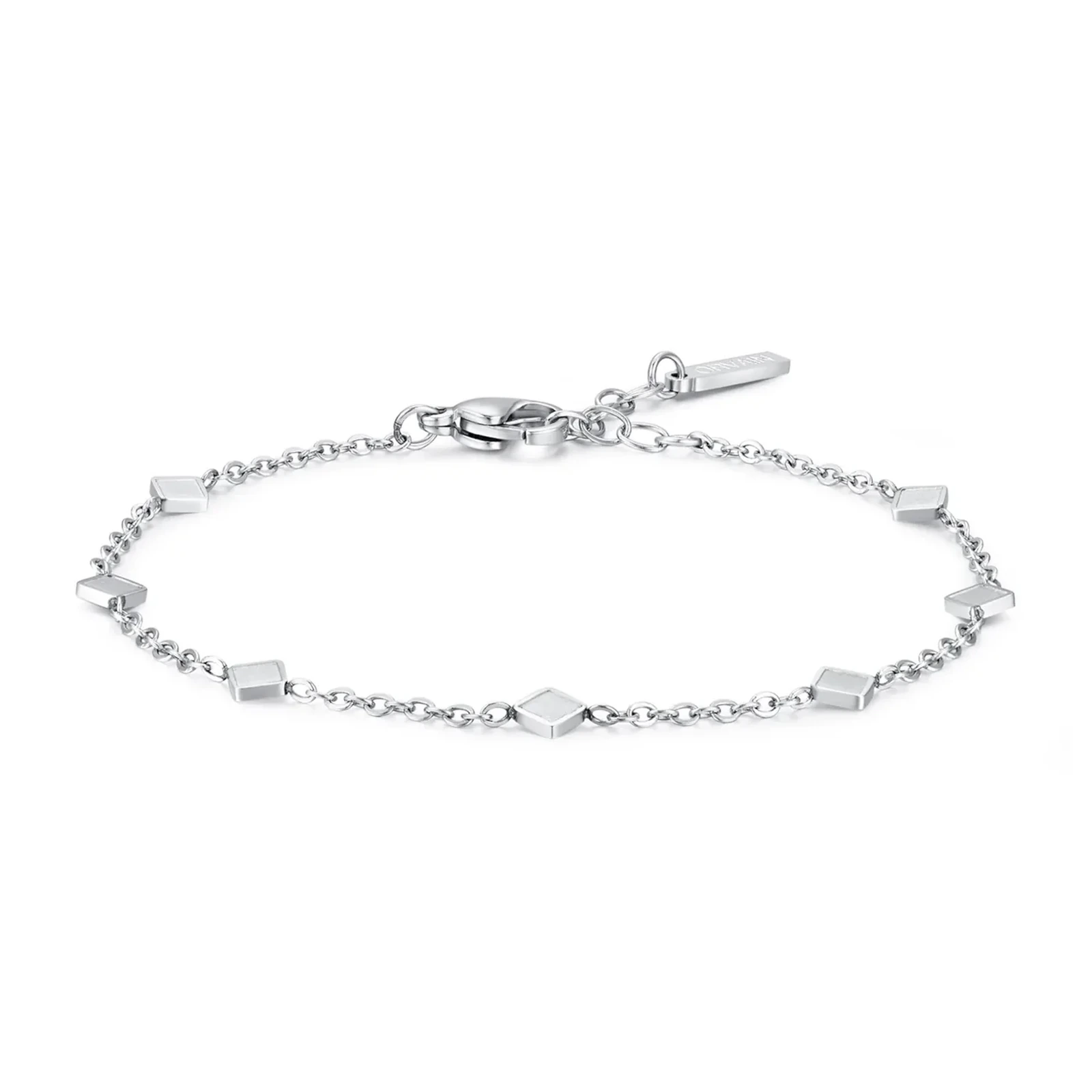
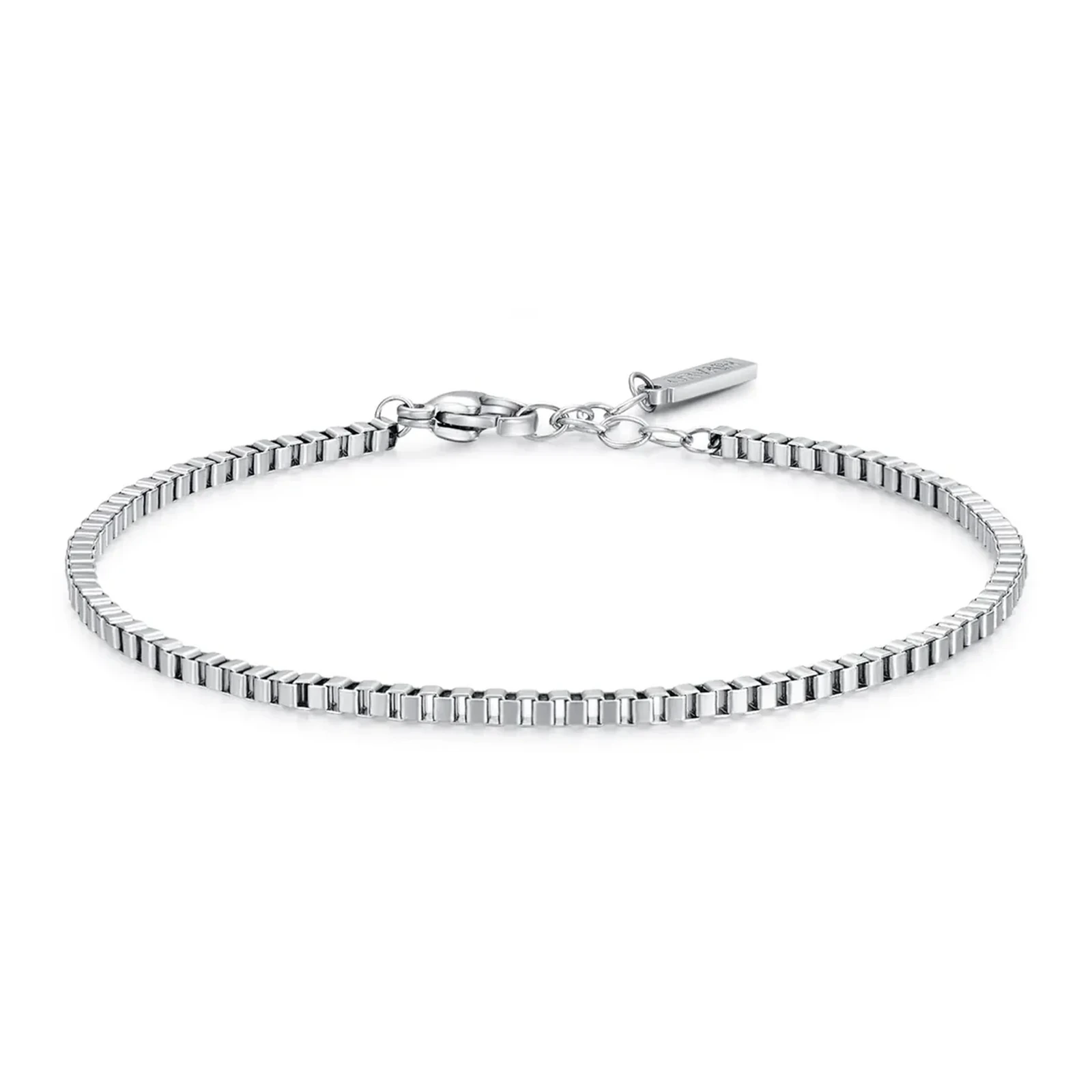
With steel that is only possible to a limited degree. This is why steel bracelets usually work with an extender at the clasp – as our four forms do. The range is limited, but it saves a trip to a workshop. Which makes it all the more important to measure the size properly beforehand.
Everyday wear
Stainless steel wins. Sweating, rain, hand soap, sport, showering: none of it troubles 316L. Silver tolerates it too, but tarnishes faster afterwards, especially in contact with sweat.
If you want a piece you put on in the morning and then stop thinking about, steel serves you better.
Design freedom
A draw, with different strengths.
Silver can be worked more finely: filigree structures, engraving, set stones, soft transitions. It is the more forgiving material for anything playful.
Steel is harder to work and therefore more limited in detail. In return it holds precise edges and flat surfaces better – exactly what reduced, geometric forms need. Where an edge should stay sharp, hardness is an advantage.
Price
It depends what is being compared.
By volume, silver is more expensive because the material is more expensive. In finished pieces, price says little about the material – it says something about design, execution, quantity and brand.
An elaborately made steel piece can cost more than a simple silver bracelet. That is no contradiction, as long as it is clear what you are paying for.
The overview
| Sterling silver 925 | Stainless steel 316L | |
|---|---|---|
| Material value | high | low |
| Hardness | soft | hard |
| Scratches | sooner, but polishable | later, hard to fix |
| Tarnishing | yes, regularly | no |
| Care | regular | minimal |
| Weight | heavier | lighter |
| Repair | readily possible | difficult |
| Adjusting length | readily possible | only via extender |
| Everyday wear | more delicate | robust |
| Fine detail | strength | weakness |
| Precise edges | weakness | strength |
What we chose, and why
ORVAIN works in 316L, and the reasons are the ones in the right-hand column: the forms live on precise edges and flat surfaces. They are meant to be worn daily without anyone having to maintain them. And they should not tarnish.
What we do not claim: that steel is the more valuable material. It is not. The value of our pieces lies in the form, in how the edges and the clasp are executed, and in the polish – things you can judge with the piece in your hand. Not in the metal price.
If you are looking for an heirloom to be reworked in thirty years, choose silver. If you are looking for an object that comes along every day and stays as it is, you are in the right place.
See The Four Forms – or go straight to the signature form, the Santorini.
Common questions
Is stainless steel cheaper than silver?
As a material, yes, considerably. As a finished piece of jewellery, not necessarily – there, design and execution decide the price, not the metal value.
Which lasts longer, steel or silver?
Steel keeps its shape longer because it is harder and does not tarnish. Silver, on the other hand, can be repaired and refinished. "Lasting longer" means something different for each material.
Can I wear steel and silver together?
Yes. Both are silver-toned and sit well together. Silver's tone is slightly warmer, steel's slightly cooler – side by side that is barely noticeable, as long as both are cleanly polished.