

Size & fit · 4 min
Which bracelet suits you? Form, width and wrist
Four constructions, four entirely different bracelets. How to tell them apart, how each behaves on the wrist, and which one belongs on yours.
ORVAIN Editorial ·
Contents
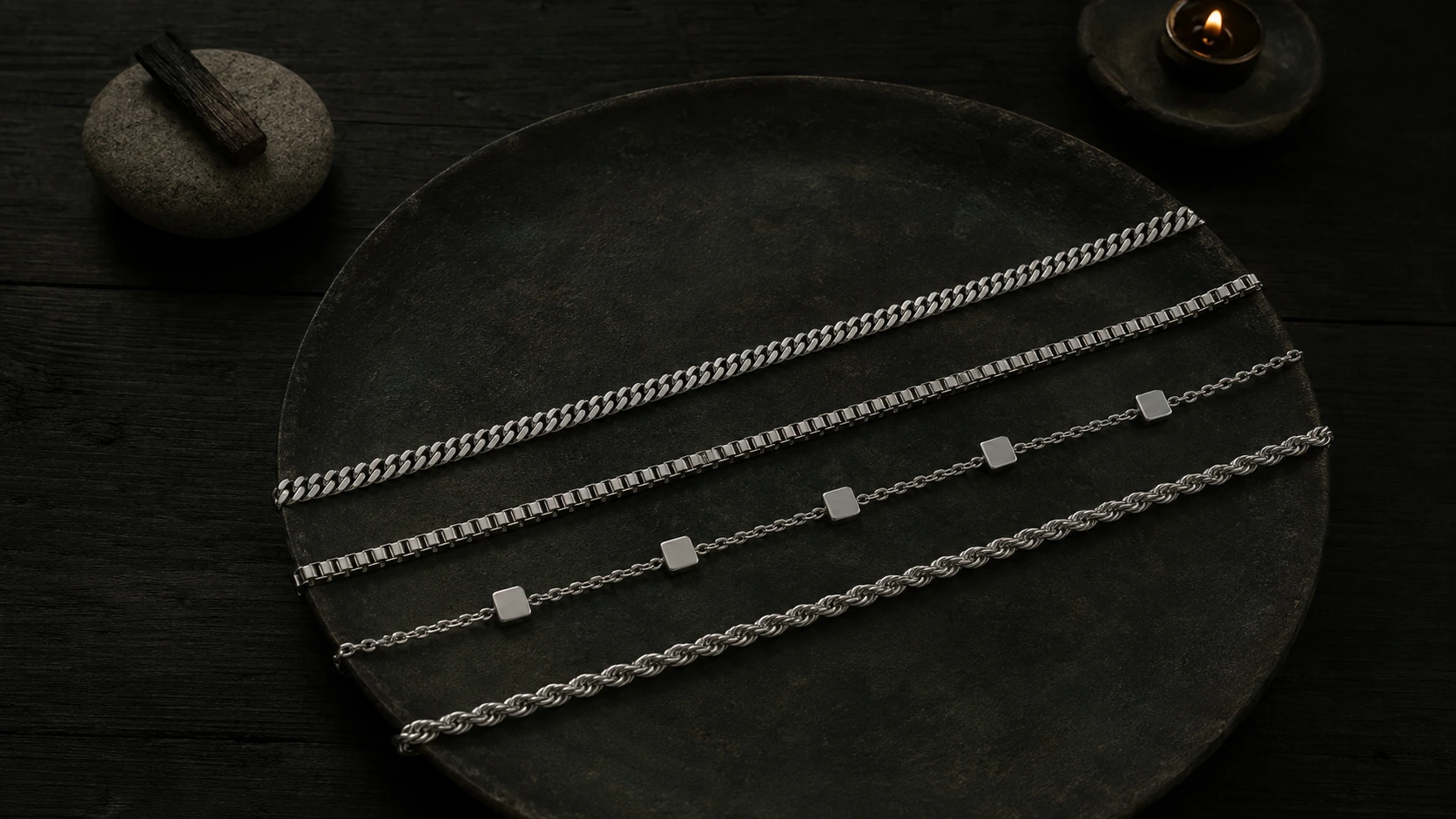
Short answer: curb chain if the bracelet should disappear under a cuff. Box chain if you want a straight, quiet line. Wheat chain if it may carry weight and movement. Cable chain with elements if it should read as a decision from across a room.
Everything below is the reasoning. It is worth reading, because the construction decides more about how a bracelet feels than material, width or price ever will.
Why construction matters more than width
Two bracelets of identical width can feel completely different. The reason lies in two properties that follow directly from how the chain is built:
- Mobility – how far the chain can twist within itself. It decides whether the bracelet follows the wrist or travels around it.
- Contact area – how much metal touches the skin. It decides whether the weight registers as pleasant or as a foreign object.
A narrow but very stiff bracelet can wear less comfortably than a wider one that settles. Which is why "how wide?" is almost always the wrong first question.
The curb chain: flat, mobile, understated
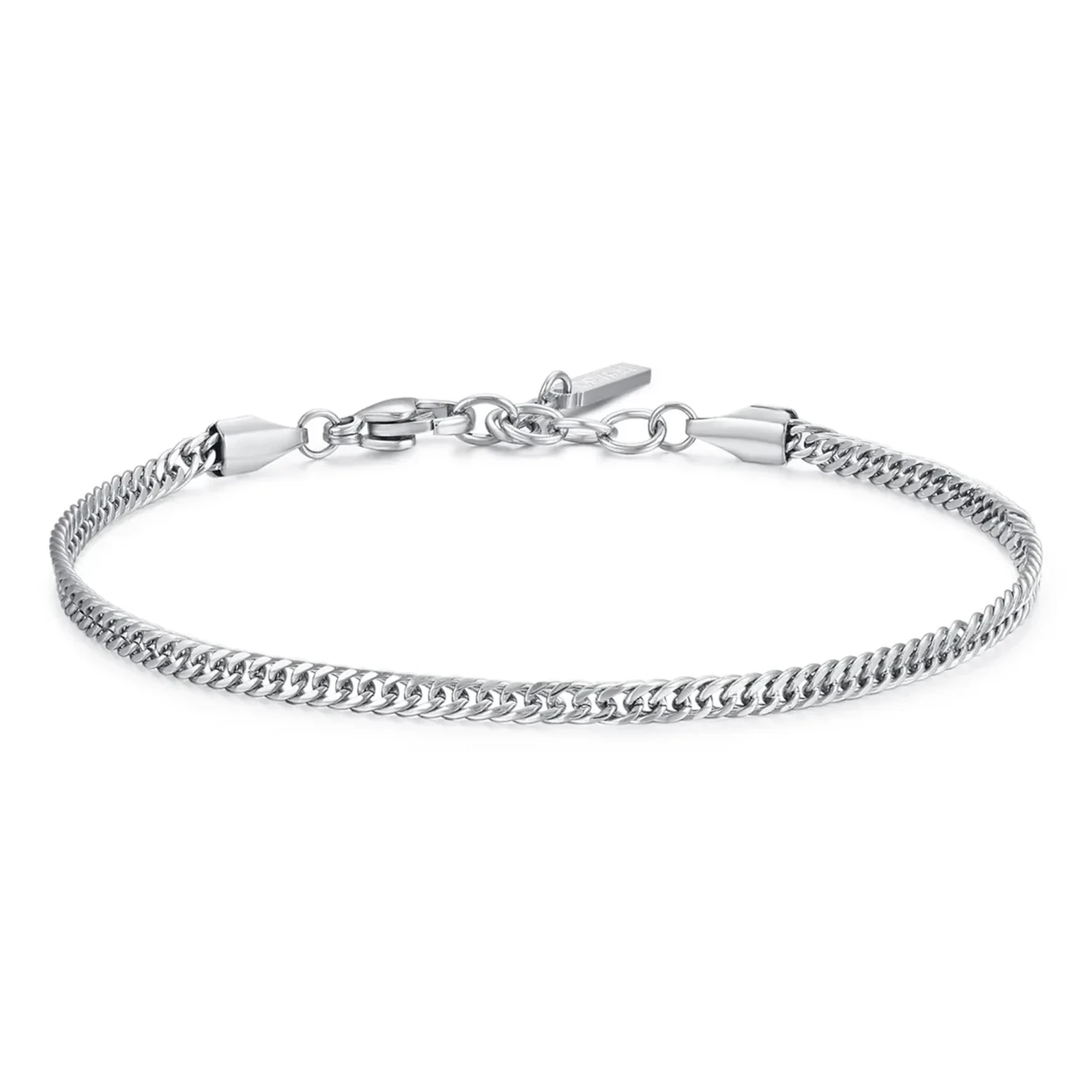
Curb links are oval, twisted around their own axis and then pressed flat. The twist makes each link sit flush against the next – the chain forms a continuous ribbon rather than a round strand.
What that means in practice:
- It lies flat rather than sitting round on top. Under a shirt cuff it adds the least bulk.
- It is highly mobile and follows the wrist instead of twisting.
- Pressing creates two filed faces per link. Those flash briefly as you move – an irregular, living sparkle.
The curb chain is the form you are most likely to forget you are wearing. That is meant as praise.
Ours: the Cuban.
The box chain: edged, form-stable, straight
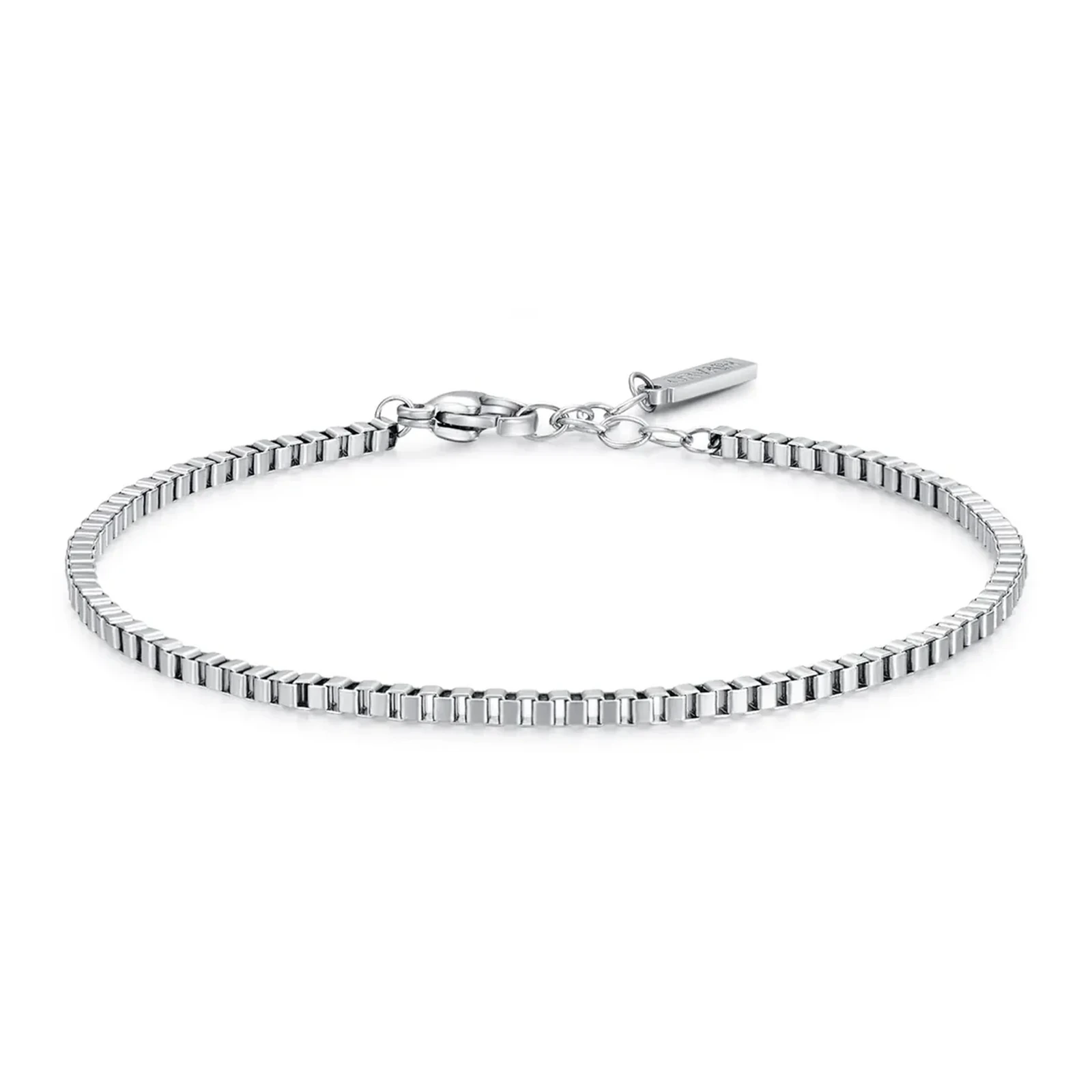
Box links are square cells set tight against one another. There is no curve for light to break on – only edges that pass it along.
- It is stiffer than a curb chain. It holds its shape and tends to roll rather than settle.
- Light comes back more evenly: not a sparkle but a continuous brightness that shifts as the chain turns.
- From a distance it reads as one straight line. Up close, as a row of small boxes.
On narrow wrists this form looks more ordered than a mobile chain. If you want to avoid the impression that a bracelet landed there by accident, this is it.
Ours: the Linear.
See the four forms
The wheat chain: woven, dense, with weight
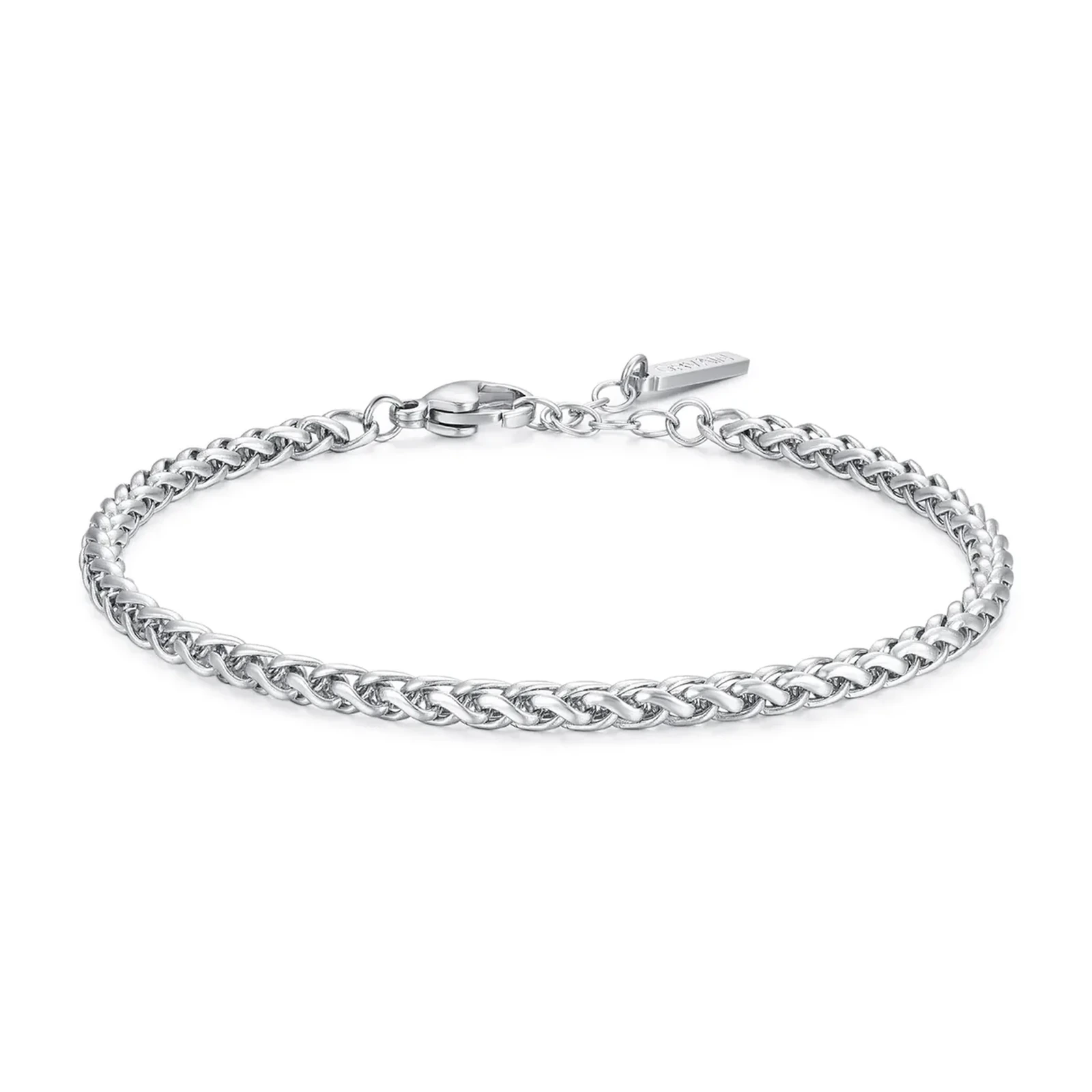
In a woven chain several strands run into one another. Every link grips the two before it, which keeps the strand round however it turns.
- It is the densest of the four and feels heavier accordingly, even at the same width.
- The surface answers light from several directions at once, because the links sit at different angles.
- It falls quietly and lies still rather than rattling.
If it matters to you that a bracelet can be felt, this is the form.
Ours: the Serpentine.
The cable chain with elements: interrupted, light, geometric
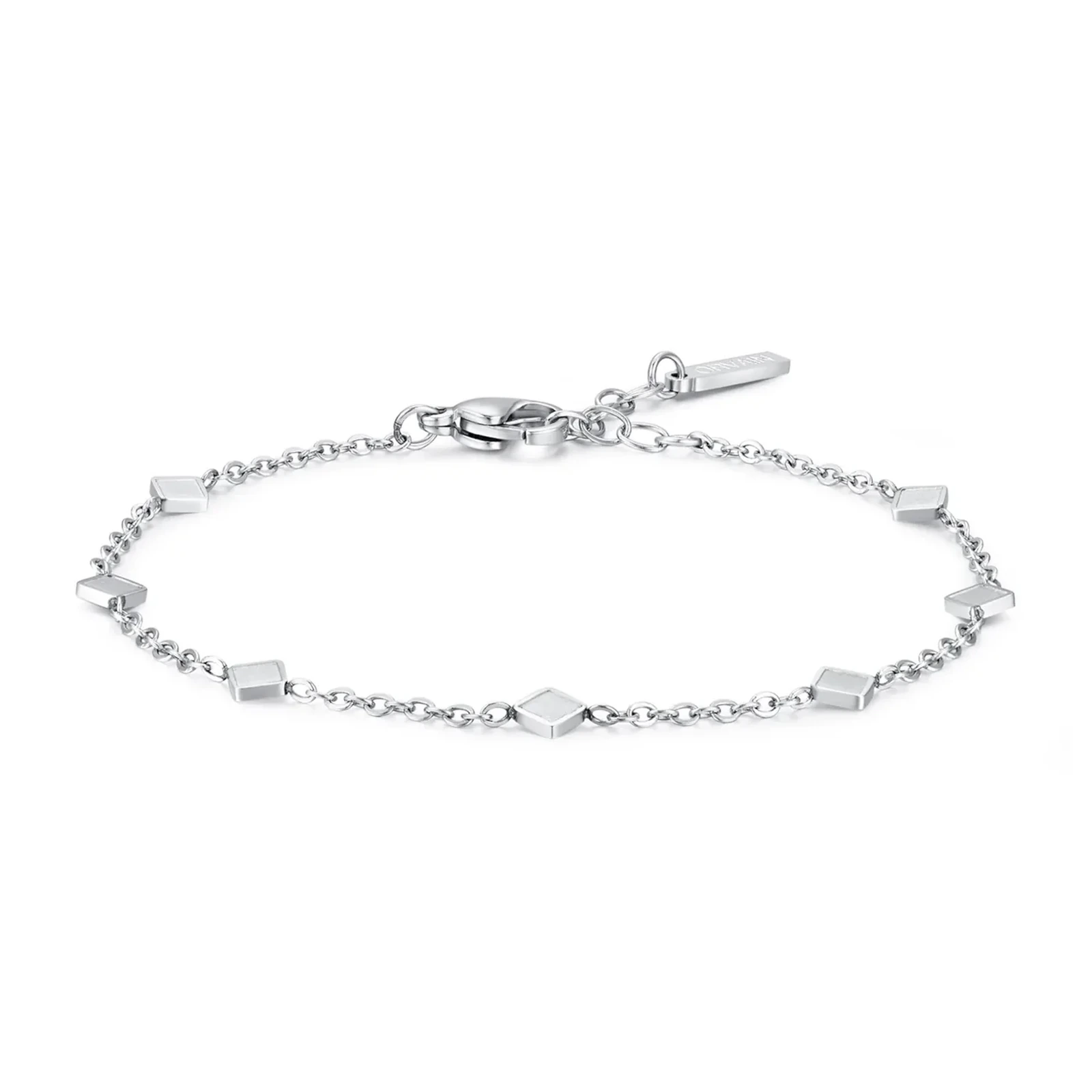
The fourth construction is not a continuous chain but a fine cable chain interrupted at even intervals by elements – in our case, cubes.
- It is by far the lightest form and works well as a second bracelet beside a watch.
- It has a rhythm: chain, element, chain, element. That alternation is what makes it legible from a distance.
- The elements turn with you – sometimes showing an edge, sometimes a face.
Ours: the Santorini.
Which suits which wrist?
There is no rule, but a few reliable observations.
Narrow wrists (under roughly 16 cm) carry edged, straight forms better. A mobile chain travels more there and quickly looks too loose. Box and cable chains are the safer choice.
Broad wrists (over roughly 19 cm) can take weight. A fine chain does not read as delicate there – it reads as overlooked. Wheat and curb chains hold their own.
If you already wear a watch, do not double the form. A link watch bracelet plus a link bracelet on the same arm is repetition. An interrupted chain beside it is contrast.
Wearing two
It works, but not arbitrarily. Two usable rules:
- Different structure, similar width. The flat curb below, the edged box above. Two chains of the same structure look like a failed pair.
- Never very fine beside very heavy. The fine one will not look delicate; it will look forgotten.
When stacking, the upper piece needs slightly more length, or it pushes the lower one away. Half a centimetre is usually enough. More on that in the piece on measuring your wrist.
What stays the same across all four
At ORVAIN the four forms differ only in construction. Material, finish and clasp are identical: 316L stainless steel, polished and silver-tone, lobster clasp with extender chain. What 316L actually means and why the alloy does not tarnish is covered in the material piece.
That is deliberate. When material and finish are constant, form becomes the only decision – and you make that one on how a bracelet feels, not on what the label says.
Common questions
Which construction is the most robust?
The woven chain, because every link grips two others and load is distributed. The cable chain with elements is the most delicate of the four and accordingly the most sensitive to pulling.
What is the difference between a curb chain and a Cuban link?
They are the same construction. "Cuban" is the common English name, often used for the heavier variants. The German term *Panzerkette* and the English *Cuban link* both describe twisted, flattened oval links.
Does a woven chain tangle more easily?
No, rather the opposite. Because the strands are laid into one another the strand stays round and does not kink the way a flat chain does. Very fine cable chains are the ones that tangle.